
Key questions for engineers, consultants, and project planners to ensure the best fit for performance, efficiency, and long-term cost.
Selecting the right industrial dryer is one of the most important decisions in many production, processing, or renewable fuel operations. Whether you’re drying biomass, biosolids, alternative fuels, food ingredients, pet food components, or waste-derived materials, the system you choose will shape performance, energy use, and product quality for years to come.
For engineers, consultants, and procurement specialists, the specification stage is where projects succeed or stall. Asking the right technical questions before designs are finalized prevents costly oversizing, integration issues, and unexpected operating costs.
This guide outlines what to ask when specifying a dryer for industrial use and how to make informed industrial dryer selection decisions that balance CAPEX, OPEX, and long-term reliability.
1. Define the Material: What Are You Drying?
Every successful drying project begins with understanding the physical and moisture characteristics of your material. These details determine the required drying temperature, residence time, and airflow – key factors in selecting the right dryer type.
Key questions to consider include:
- What is the moisture content of the material at the inlet and the target level after drying?
- Is the material uniform or variable in size, shape, or density?
- Is it abrasive, sticky, or prone to clumping?
- What throughput, input volume, or output is required?
- Will drying be continuous or batch-based?
Understanding these properties early helps ensure the dryer is sized correctly and matched to the process conditions, energy sources, and production goals.
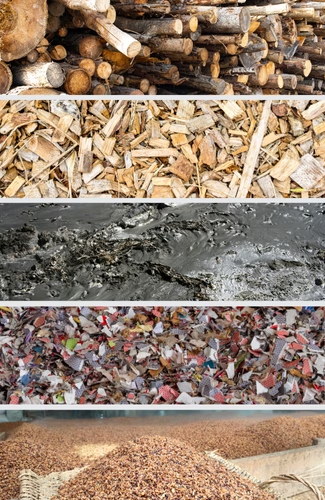
Material properties directly influence dryer selection. Characteristics such as moisture variability, particle size, density, flowability – as well as how the material behaves during drying – help determine which drying concept is appropriate. Low-temperature belt dryers are well suited for uniform, bulk materials such as biomass, biosolids, digestate, agricultural byproducts, food or pet food ingredients, and waste-derived materials. Other dryer types may be selected for coarser or more abrasive materials or where different residence times are required.
2. What Temperature Requirements and Sensitivities Matter in Dryer Selection?
Temperature management is central to both product quality and process safety. Some materials degrade, combust, or lose critical properties at high heat. Others require steady temperature curves to maintain consistency.
Low-temperature drying offers gentle, controlled moisture removal that helps protect material quality. For instance, STELA’s belt dryers maintain precise temperature and moisture targets to deliver consistent, high-quality output while reducing the risk of over-drying or thermal damage.
3. What Heat Sources Are Available, and How Do They Affect Dryer Design?
Before specifying a dryer, evaluate what heat sources are already available on site:
- Can low-grade or excess heat from the facility be reused?
- What primary heat sources are available, and what transfer media (steam, hot water, thermal oil) are used to deliver that heat?
- Are multiple heat sources at different temperature levels available that could be used in combination?
- What is the cost and availability of the fuels used to generate heat?
Leveraging excess heat can significantly reduce energy costs and emissions. When excess heat is limited, STELA’s RecuDry® system can recover and reuse energy within the drying process to deliver a high-efficiency, low-emission solution.
Direct heating introduces moisture into the drying air through combustion, while indirect heating avoids this effect and reduces spark-related risks.
Tip: Dryer configuration should follow the energy conditions on site. If your facility has limited excess or low-grade heat and you want to maximize energy recovery, a RecuDry® configuration can deliver strong efficiency gains. If instead you already have abundant excess heat, a simpler indirect heat approach may offer a lower-cost path with similar performance.
4. Plan for Integration, Not Isolation
A dryer performs best when it is fully integrated into the process, not treated as a standalone unit. Early collaboration allows for better thermal matching, smoother material handling, and a cleaner overall plant layout.
Key questions to consider:
- How will material flow to and from the dryer?
- Can the system integrate with existing control and automation platforms?
- Are there height, footprint, or access constraints?
- How could a modular design improve flexibility in phased projects?
Earlier dryer projects often used a “dryer island” approach, treating the dryer and its energy supply as an isolated system. Today, integrated drying solutions view the dryer as part of the broader plant energy balance. In many operations, the dryer can function as a heat sink, absorbing excess heat from other processes such as resin production or hot water loops. By routing this excess heat through the dryer, operators can reduce or eliminate the need for separate cooling towers, lowering electrical demand while improving overall plant efficiency. Integrated drying allows producers to maximize available excess heat, reduce emissions, and optimize performance across the entire process.
For an example of this approach in practice, see the Swiss Krono OSB project:
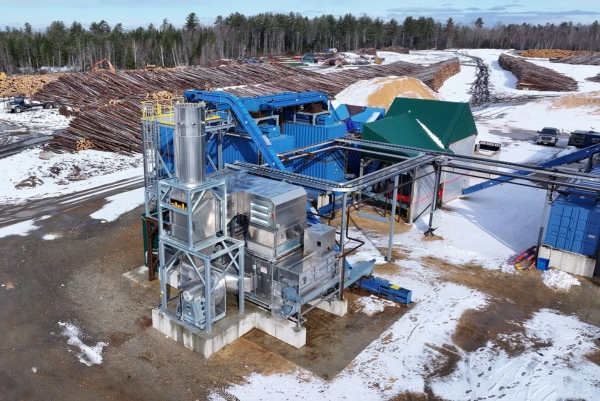
Case Study: Integrated Drying at a Maine Biochar Facility
A Maine biochar start-up needed an integrated drying step for green wood chips. STELA’s low-temperature system delivered stable moisture and smooth process integration.
5. How Should You Balance CAPEX and OPEX for True Lifecycle Efficiency?
True value in industrial drying comes from balancing capital investment (CAPEX) with long-term operating efficiency and cost (OPEX). Low-cost systems may appear attractive initially but often carry higher energy, maintenance, or downtime costs over time.
When comparing options, ask:
- What is the energy use per ton of dried material?
- How frequent and how costly is maintenance?
- What is the expected service life and warranty?
A potentially higher initial investment in a low-temperature, energy-efficient system can yield lower long-term costs and greater reliability.
When evaluating alternatives, engineers should consider the full drying and emissions package required for each technology. Conventional drum systems often require additional emission-control equipment such as cyclones, ESPs, or RTOs, which can add significant capital cost, increase operating expenses, and complicate permitting.
In contrast, low-temperature drying minimizes VOC formation, allowing many operations to avoid RTO-based emission controls and the associated costs. Reviewing the complete system, dryer plus required emissions components, provides a more accurate comparison of total lifecycle cost and operational impact.
6. What Should You Ask About Reliability, Maintenance, and Operator Experience?
Downtime in drying operations can impact the entire production line. System reliability and service access should be part of every specification checklist:
- What is the system’s uptime track record in similar applications?
- How accessible are critical components for cleaning and repair?
- What automation and diagnostics are available for predictive maintenance?
- Is spare parts supply readily available?
Reliable dryer performance often comes from thoughtful mechanical design, including low-temperature operation, slower-moving components, and robust construction. These features help reduce wear, extend uptime, and shorten maintenance intervals. For an example of how this works in practice, see our recent project in Prince George.
7. When Should You Involve a Drying Partner?
One common planning challenge is involving the dryer manufacturer too late in the process. Early collaboration during the conceptual or process-design stage helps ensure that the drying system is properly matched to process conditions, energy sources, permitting and space constraints.
Involving the dryer partner too late might limit design flexibility and increase both capital and integration costs.
When brought in early, a qualified drying partner can:
- Evaluate available heat sources and integration opportunities
- Right-size capacity and energy systems for realistic throughput targets
Early involvement also helps identify opportunities for excess-energy integration so the system uses as much available heat as possible instead of relying on dedicated energy supply alone.
Engaging your dryer partner before detailed engineering begins helps prevent rework, oversizing, or undersizing, and missed energy-saving opportunities.
In multi-stage projects, belt dryers can be extended rather than duplicated, allowing long-term scalability without requiring a second full dryer line.
Conclusion
Specifying a dryer is more than selecting equipment – it is about designing a complete, integrated solution that supports performance, sustainability, and long-term reliability.
With over 500 installations worldwide, STELA Drying Technology brings proven expertise in low-temperature belt drying, excess-heat recovery, and system integration across industries. Our engineers work closely with clients to ensure every drying solution is efficient, reliable, and ready for the future.
Learn more about specifying the right dryer for your industry at our products page.
Bonus: 5 Common Dryer Design Mistakes to Avoid
- Ignoring feedstock variability – causes inconsistent output and frequent adjustments.
- Sizing errors – oversizing increases CAPEX; undersizing limits plant output.
- Neglecting local energy availability – missing opportunities to use excess heat.
- Overlooking automation and operator needs – reduces reliability.
- Using unsuitable construction materials – accelerates corrosion and wear.